







The Deepal Manufacturer!
AUTO-007, the Global Automobile Business department of Xiamen ITG Holding Group Co., Ltd., is your ONE-STOP shop for everything related to Chinese automobiles. We are a team of passionate professionals dedicated to delivering exceptional service and fostering international automotive trade.
-
![Deepal S7 Electric Car]() Deepal S7 Electric CarPrice : 15,000 USD FOB Price Term : EXW / FCA / CIF / CIP Payment Term : TT / LC / OA Logistics : Container / RORO / Train / Truck Lead Time : 10-15 Daysread more
Deepal S7 Electric CarPrice : 15,000 USD FOB Price Term : EXW / FCA / CIF / CIP Payment Term : TT / LC / OA Logistics : Container / RORO / Train / Truck Lead Time : 10-15 Daysread more -
![Deepal SL03 Extend Range Electric Car]() Deepal SL03 Extend Range Electric CarPrice : 15,000 USD FOB Price Term : EXW / FCA / CIF / CIP Payment Term : TT / LC / OA Logistics : Container / RORO / Train / Truck Lead Time : 10-15 Daysread more
Deepal SL03 Extend Range Electric CarPrice : 15,000 USD FOB Price Term : EXW / FCA / CIF / CIP Payment Term : TT / LC / OA Logistics : Container / RORO / Train / Truck Lead Time : 10-15 Daysread more -
![Deepal S7 Extend Range Electric Car]() Deepal S7 Extend Range Electric CarPrice : 15,000 USD FOB Price Term : EXW / FCA / CIF / CIP Payment Term : TT / LC / OA Logistics : Container / RORO / Train / Truck Lead Time : 10-15 Daysread more
Deepal S7 Extend Range Electric CarPrice : 15,000 USD FOB Price Term : EXW / FCA / CIF / CIP Payment Term : TT / LC / OA Logistics : Container / RORO / Train / Truck Lead Time : 10-15 Daysread more


Why choose us
Nationwide Reach
With over 160 dealerships across China representing a multitude of brands, finding your dream car at low price is effortless.
Fast Delivery
We prioritize fast and efficient delivery, getting you behind the wheel of your car sooner rather than later.
After-Sales Service
Our commitment extends beyond the sale. We offer comprehensive after-sales services and readily available spare parts for long-term peace of mind.
Benefits of Electric Vehicles


Lower running cost: Since the soaring costs of diesel or petrol do not apply to your electric vehicle, you can save a lot of money almost regularly.
Cheaper maintenance: Fuel-powered vehicles require regular maintenance because they have a lot of moving parts. Comparatively, EVs have fewer moving parts, and therefore the cost of maintenance is lower.
Incentives and tax benefits: As the Government of India is encouraging the purchase of EVs, several policies and incentives are offered to buyers for investing in this new technology.
Better performance: EVs formerly had a reputation for being impractical, but the innovation has come a long way since.
Zero tail-pipe emissions: Pure EVs have zero tail-pipe emissions which reduces air pollution. So, one of the benefits of electric vehicles is improving our environment.
Smooth and quiet driving experience: Not only are EVs easier to drive but they are also quiet on the road, contributing to lesser sound pollution.
Convenience of home charging: You need not queue up at fuel stations because you can conveniently charge your EV at home. With newer innovations in EVs, it is possible to charge your car or bike quickly.
Spacious cabin: As EVs employ fewer moving parts, it has provided car makers the opportunity to design spacious cabins and offer a larger boot space. Some models also have storage space under the hood because there is no conventional ICE.
Future proof: The inclination towards EVs is observable with buyers preferring them owing to their lower running costs and maintenance costs.
System Architecture of 4 types of electric cars
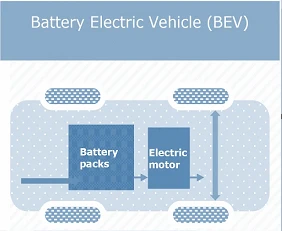
Battery Electric Vehicles (BEVs)
BEVs are also known as All-Electric Vehicles (AEV). Electric Vehicles using BEV technology run entirely on a battery-powered electric drivetrain. The electricity used to drive the vehicle is stored in a large battery pack which can be charged by plugging into the electricity grid. The charged battery pack then provides power to one or more electric motors to run the electric car.
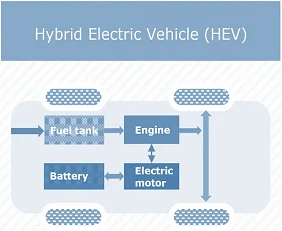
Hybrid Electric Vehicle (HEV)
HEVs are also known as series hybrid or parallel hybrid. HEVs have both engine and electric motor. The engine gets energy from fuel, and the motor gets electricity from batteries. The transmission is rotated simultaneously by both engine and electric motor. This then drives the wheels.
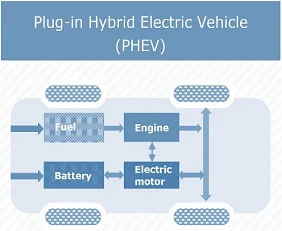
Plug-in Hybrid Electric Vehicle (PHEV)
The PHEVs are also known as series hybrids. They have both engine and a motor. You can choose among the fuels, conventional fuel (such as petrol) or alternative fuel (such as bio-diesel). It can also be powered by a rechargeable battery pack. The battery can be charged externally.
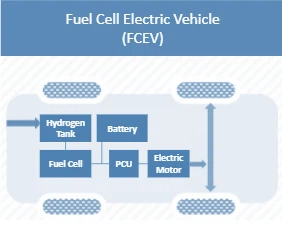
Fuel Cell Electric Vehicle(FCEV)
FCEVs are also known as Zero-Emission Vehicles. They employ 'fuel cell technology'to generate the electricity required to run the vehicle. The chemical energy of the fuel is converted directly into electric energy.
Components of Electric Car
Battery
This is where the magic happens – the battery pack stores all the electricity needed to power the motor and drive the car forward. This is like the power bank for your car, providing electricity to run all the features and gadgets inside, from the infotainment system to the air conditioning.
Charge port
This is your car's lifeline to the outside world. It's where you plug in to get your car juiced up and ready to roll.
DC/DC or DC/AC converter
Ever wonder how your car powers all those accessories like lights and windshield wipers This device converts the high-voltage electricity from the battery into lower-voltage power for all those cool features.
Electric traction motor
This is the powerhouse of the car, driving the wheels with lightning-fast acceleration, thanks to the electricity from the battery pack.
Onboard charger
Like a mini power station on wheels, the onboard charger converts the AC electricity from the charge port into DC power to charge the battery. It's smart too, keeping an eye on the battery's health while it charges up.
Power electronics controller
This is the brain of the entire operation, managing the flow of electricity from the battery to the motor. It's like the conductor of an orchestra, making sure everything runs smoothly.
Thermal System (Cooling)
Just like you need to stay cool on a hot day, so does your car. The thermal system keeps all the important components at the right temperature for peak performance.
Transmission (Electric)
Finally, we have the transmission, which transfers the power from the electric motor to the wheels, propelling you down the road with a smooth and silent ride.
Charging Times of Electric Cars
The time it takes to fully charge an electric car can vary depending on battery size and power supply, but on average, a full home charge will take approximately six hours. The battery can be charged for any length of time, in accordance with the length of the journey, just as there is no need to always have a full tank of petrol.
The time it takes for a car to become fully charged is between 30 minutes and 12 hours. A typical electric car with a 60 kWh battery takes around 8 hours to charge from empty to full using a 7 kW charging point. For convenience, drivers often top up their battery during traveling, while many cars are able to add up to 100 miles of range in around 35 minutes using a 50 kW rapid charger.
FAQ
As one of the leading deepal suppliers in China, we warmly welcome you to wholesale discount deepal from our company. All our products are with high quality and competitive price. For more cheap products, contact us now.